
Quantum Computing!

Our son Luke is pretty techie. He asked me to do a post on Quantum Computing - I said, "The people who read my blog may not like a techie post." But we love our son and he thinks you'll like it, so we're going to give it a shot.

I didn't know ANYTHING about Quantum Computing before today - I did my research. It's actually pretty cool. But I had to understand it like I was 10 years old, so that's where I started this.
We're gonna talk Quantum computing and make it sound as sexy as Sade singing "No Ordinary Love". We're going to make you the smart one in the room - the one that women (or men) throw themselves at for your big brain. It's not going to hurt a bit.

I had a professor from Alabama who taught microeconomics in my master's program at Eastern University. If you've ever taken microeconomics, you know that there's a lot of calculus, linear algebra and formal proofs in theory. I'm not a math guy. But she had this sweet southern accent and would put us at ease by saying, "Don't you worry about the math - I'm going to make it so sweet, it's gonna melt in your mouth..." While I can't attest that she was 100% correct in her promise, I wish she was teaching you quantum computing rather than me.
Shreyas Naphad wrote an amazing article for Medium called Give Me 5 Minutes, And You’ll Understand Quantum Computing. I've paraphrased his article to dumb it down to MY understanding:

The laptop or phone that you're reading this post on is throwing the information at you in the form of ONES and ZEROS called BITS. If it's a ONE, it's on, high voltage, light, charged or magnetic north...If it's a ZERO, it's off, low voltage, dark, uncharged or magnetic south.... Think of it as a light switch - ON or OFF.
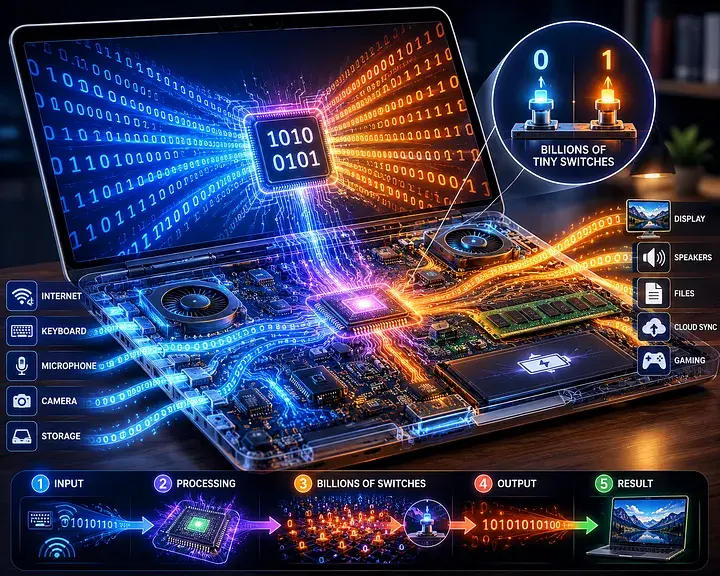
That's how a "regular" computer stores information.
Enter the quantum computer (Jurassic Park drums here...DA DUM DA DUM DA DUM)...
This is not your grandmother's computer! A quantum computer doesn't use bits. It uses QUBITS! What in the tarnation is a QUBIT??
Coins have a heads and tails side - we'll say HEADS is ON and TAILS is OFF. What if you could spin that coin and it stayed spinning? It's never ON and it's never OFF...but it's in a constant state of ON AND OFF.

QUBITS can be OFF, ON, or in a state where it behaves like a combination of both at the same time. This is called SUPERPOSITION.
If you're saying, "who cares? Why does it matter?", try to imagine the difference between a regular computer with bits and bytes and a quantum computer with qubits:
Imagine you're trying to find a specific key to open a door. That key is hidden somewhere among a million different boxes:
TRADITIONAL computers will check each box, one after another until it finds the key. That takes time.
QUANTUM computers gather information differently - it looks at the information as a whole to gather possible paths before deciding which way to go - A quantum chip sends signals to other quantum chips in the same box, and everybody works together. They do this through microwave and/or either photons, laser or optical links. If a quantum computer talks to another quantum computer, it uses entangled photons and a quantum-safe networking protocol.
If your head is starting to hurt like mine, let's give you a couple of real-world examples of regular computers verses quantum computers:

A physics problem tackled by a Cray Supercomputer would take 47 years to come up with an answer to a problem. A Quantum Computer came up with the same answer in 6 minutes.
An RSA encrypted 2048 bit number would take longer than the age of the universe (a trillion, trillion years) to factor an answer. A Quantum Computer could do it in hours. (~8 hours).
If Quantum computing is all that, why are we still using traditional computers with bits and bytes when we've got this speed demon Quantum Computer?
As of this post, the fastest traditional computer is the El Capitan supercomputer, and the fastest quantum computer is the Jiuzhang 4.0. Here's a side-by-side comparison of the two:
Speed Comparison
Metric | Jiuzhang 4.0 (Quantum Computer) | El Capitan (Supercomputer) |
Architecture | Photonic quantum system (3,050 photons) | Classical exascale system (CPU + GPU) |
Peak Performance | Generates complex quantum samples in 25 microseconds | 2.79 quintillion (2.79 × 10¹⁸) calculations per second |
Equivalent Classical Time | Same task would take >10⁴² years on El Capitan | Runs classical workloads in hours instead of weeks |
Benchmark Context | Demonstrates quantum advantage — tasks impossible for classical machines | Fastest classical machine ever built, optimized for nuclear security and AI |
Energy Efficiency | 92% source efficiency, 51% total system efficiency (quantum optical system) | 58.89 billion calculations per watt (ranked 18th on Green500 list) |
Both systems are at the top of their game for different reasons.
Jiuzhang 4.0: For specific quantum sampling problems, it is astronomically faster — literally beyond the reach of any classical supercomputer. That’s why researchers say it achieves “quantum supremacy.”
El Capitan: For general classical workloads (AI, simulations, nuclear security), it is the fastest supercomputer ever built, capable of exascale performance. But it cannot match Jiuzhang 4.0 on quantum‑specific problems.
Quantum computers are fickle and fragile. Under ideal conditions, they work like champs. But life often isn't ideal:
Qubits (Quantum processing) are extremely sensitive to noise. The slightest vibration, magnetic field fluctuations, or thermal changes can cause a quantum computer to collapse their quantum state. When that happens, it makes mistakes and the data it produces becomes unreliable and suspect. Think of a spinning coin on a desk and you bump the desk.
They're expensive! A small research-grade quantum computer can cost millions of dollars and the parts to manufacture one aren't readily available.
They need to be kept as close to absolute zero temperature as possible - a typical quantum computer processor generally operates at 20–100 millikelvin (mK) — that’s 0.02–0.1 K, or just thousandths of a degree above absolute zero. To put this in perspective, they need to be colder than outer space. To obtain this degree of cold, they need to be kept in ultra-stable cryogenic environments.

The engineering/infrastructure systems that operate a commercial scale quantum system are challenging; they need high-precision lasers and control electronics, massive shielding from electromagnetic noise and a new fabrication technique for the manufacturing of the qubit chips themselves.
With all these roadblocks, why are we even pursuing the idea of quantum computing?
There have been major advancements in overcoming the challenges associated with Quantum computing. Think back to your very first home PC - that giant box with the 5 1/4 floppy drive and a tiny hard drive that cost between $3,000 and $5,800 dollars (adjusted for 2026 dollars, it would be $10,500 to $16,000 today). Your smartphone is literally hundreds to thousands of times faster than these early PCs and can run dozens of apps simultaneously compared to the single processing capability of a 286 system.
We're in the early years of Quantum computing and like everything else in technology, it will get better, faster, cheaper and smaller in time.
What are the potential benefits that a Quantum computer can provide?
Accelerated Drug discoveries and material science. (Quantum computers cut drug development time from decades to a few years. They enable the design of new materials for superconductors, stronger alloys and advanced batteries.
Optimization of Complex Systems. A quantum computer can solve large-scale optimization problems in supply chains, logistics and autonomous vehicle testing by simulating millions of scenarios quickly.
Financial Modeling and Risk Analysis. The algorithms a quantum computer can produce will improve financial forecasts, trading strategies, portfolio optimization and risk models quickly and in real time.
Artificial Intelligence and Machine Learning. (this one scares me a little) - Quantum-enhanced AI can train deep learning models to work faster, optimize feature selection and handle exponentially larger datasets than current systems.
Cryptography & Communication Security. (This one scares me a LOT...) Quantum cryptography can break current public-key encryption (Think of the 1992 movie Sneakers with Robert Redford). Conversely, it can provide ultra-secure communications through something called quantum key distribution.
Scientific Simulations. Quantum computers can model systems, weather patterns and complex physical processes which will lead to breakthroughs in physics, chemistry and climate science.
Data Analysis & Search. Something called Grover’s algorithm can be used by quantum computing to speed up unstructured searches. Quantum computing can also analyze large datasets for patterns and anomalies much faster than classical methods.
There you have it. Quantum computing in a nutshell. Well, more like a coconut sized shell. If you like the post and got something out of it, you're welcome. If you didn't like the post and are now drinking Vodka straight from the bottle to ease your headache, blame Luke.
Love ya, buddy.


Great post! Quantum computing is so interesting. The coin analogy nailed it. What stops the coin spinning, though? Turns out that it’s just looking at it. Google “the double slit experiment” and see how observation can change the outcome. This is a rabbit hole that can really mess with how you see the world