
AI...AI...AI...AI...Open the pod doors, Hal.

In 1968, Director Stanely Kubrick released a film called 2001: A Space Odyssey. The movie outlined the story of a spacecraft called Discovery One and its journey to Jupiter. The spacecraft's operations were controlled by HAL 9000, which was an onboard computer with a human-like personality. At some point, HAL 9000 makes a judgement about a problem it found with the ship and the astronauts aboard disagree with HAL's assessment. The resulting conflict between man and machine makes the humans feel that the computer system is malfunctioning and takes steps to turn HAL off. But HAL's self-preservation mode kicks in and it turns against the humans killing most of them in order to continue the mission parameters.
For geeks like me who grew up reading science fiction books by Robert Heinlein and Arthur C. Clarke, this movie was way ahead of its time and trendsetting. It was also the first movie in my memory to pit man against computer or robot. Later, artificial intelligence would rear its ugly head again in War Games in 1983 and then The Terminator a year later in 1984. It's no wonder people looked at AI suspiciously!
Remember the first time you heard about smart phones? There was no such thing before 2007. How about Facebook? Not until 2004, Twitter? 2006. Uber? 2009. Ring Doorbells, 5G networks, Electric Bikes and Scooters, Smart Thermostats, Apple Watch, Home DNA testing, Contactless payment options, wireless earbuds, digital wallets, food delivery services, VR Gaming? All within the last 10 years.
AI is everywhere we look and has invaded just about every aspect of our lives. We all pretend to know what AI is and maybe even have a general understanding of the concept, but it might surprise you to know the concept of artificial intelligence isn't a recent invention. It goes back almost 70 years when the term "artificial intelligence" was coined at a Dartmouth Conference in 1956. Back then, when the technology was new, early AI models focused on problem solving and symbolic reasoning. One program called Logic Theorist was created to solve mathematical theorems.
But I'm getting ahead of myself here. I don't want this to be a science or technology lesson. I don't use AI to write my posts, but out of curiosity, I posed the following questions to Chat GPT:
Explain what AI is as if I were a 5-year-old or someone who knows nothing about technology and include how it started, the history and progression of it from start to today, the applications AI is used for and why we need to keep up with the world from an AI perspective.
In less than 5 seconds, the program spit out close to 1,500 words about what AI is in simple terms, how it started, what we use it for today in real life, why we need it to stay competitive and why we need such massive data centers to run it.
Without regurgitating everything, here's what I got out of it:
Artificial Intelligence doesn't think like we do. It learns by looking at tons and tons of examples and comes up with a logical response on what it reads. If you were to show an AI program 1,000 pictures of cats, it would start to notice similarities like the pointy ears, whiskers, etc. It would establish PATTERNS.
It's a guessing machine or a helper that learns from examples it's heard or seen.
Because it gets its "knowledge" from the inputs it sees, it's possible to create a bias within the data it spits out. For example, if all the program sees is information that says that Adolf Hitler was a great humanitarian who did amazing things to benefit the world, that's the output you would get if you asked about him. You'd never know the atrocities he committed if there was no historical data on the subject.
Somewhere around the 1990s, AI got competitive - the programs got better, the algorithms more intense, the amount of input it could see increased dramatically. Then in the 2000s, computers got faster and AI could recognize faces, understand speech and translate languages.
Around 2010, Deep Learning or the Big Boom happened. The technologists created AI systems inspired by the brain called neural networks. These networks "learned" from millions of examples and gave way to things like Siri, Alexa, Netflix recommendations.

Now in the 2020s, we've got image generators, programs that write, draw, code and analyzes data. We moved from cute science project to global infrastructure overnight.
Today's AI is firmly incorporated in our lives:
Helping People Work:
• Writing emails
• Summarizing long documents
• Analyzing data
• Coding
• Research
Helping People in their day to day lives:
• Maps and GPS
• Voice assistants
• Spam filters
• Photo organization
• Translation
Helping Society through:
• Medical imaging
• Weather prediction
• Fraud detection
• Traffic systems
• Energy grid management
Helping to Create:
• Art
• Music
• Stories
• Designs
• Videos
If you couldn't spell "AI" before and you're wondering how to get started in learning about the technology, there are several programs I'd recommend for getting your feet wet. Many of them offer either a free version or a try before you buy opportunity.
ChatGPT by OpenAI is a good general-purpose assistant - it can handle text, images, voice, code, file analysis and web search questions. Other top assistants are Google Gemini, Claud Opus and Microsoft Copilot.
Midjourney is a top choice for high-fidelity artistic images. Other assistants are Canva AI and Adobe Firefly.
CapCut is a top choice for video creation and editing with Veo 3 a good second choice.
ElevenLaps is top rated for Voice synthesis with DeepL and Whisper-based tools for transcription and translation.
Claude Code is top tiered for coding.
Claude AI is top rated for writing, editing and content creation along with ChatGPT and QuillBot.
Perplexity ai is great for search, rescue and knowledge work with ChatGPT for deep research.
Microsoft Copilot and Notion AI are great for productivity and workflow automation tools.
New AI software programs are being introduced almost daily it seems. Some of the programs weren't around even six months ago while others have been discontinued or upgraded since their inception.
Nowadays, AI has been modernized, demonized, moralized and compromised. There are AI programs so powerful that the designers are afraid to release it. There are models that the government won't allow to be used by the military because the safeguards and handrails aren't in place.
It's not like AI is going away - The expression that the genie is out of the bottle certainly fits. In order to stay current with the rest of the world on an economic, societal and environmental basis, we're going to need to play together in the big sandbox and AI is going to have a major impact on how well that works.
Currently, the United States is in a neck-to-neck competition with China at a national level and companies like OpenAI, Google, Anthropic, Amazon, ByteDance and Zhipu AI are competing at a corporate level. But staying on the forefront of AI isn't just about dominance in the artificial intelligence market, it's also about continuing to be able to survive and co-exist with the rest of the world for:
Economic growth - (Attracting new players in biotech, finance, advanced manufacturing)
National Security - (cyber defense, military logistics, threat detection, intelligence)
Global influence - (setting the guidelines for the rest of the world in AI ethics, standards)
Sorry, I'm getting all geeky again!
Look at it this way - Suppose you've been existing all fat, dumb and happy for years with a bow and arrow, horse and buggy and well, fire.... Life is good. Then some stranger comes along with rifles, automobiles and lasers...pretty soon, your "good life" is going to be taken away from you by the next best thing. The door is open to have your life forever changed by strangers who may not have your best interest at heart. It's important to stay current with what's going on in the rest of the world for survival.
The backbone of AI doesn't stop at the application level. In order to run the software, giant databases are needed to get the information from. I wrote a post previously about data centers and the push for a new hyper datacenter to be built here in the Lehigh Valley. There's considerable opposition to this data center primarily because of its proximity to Parkland High School - the opponents of this data center claim:
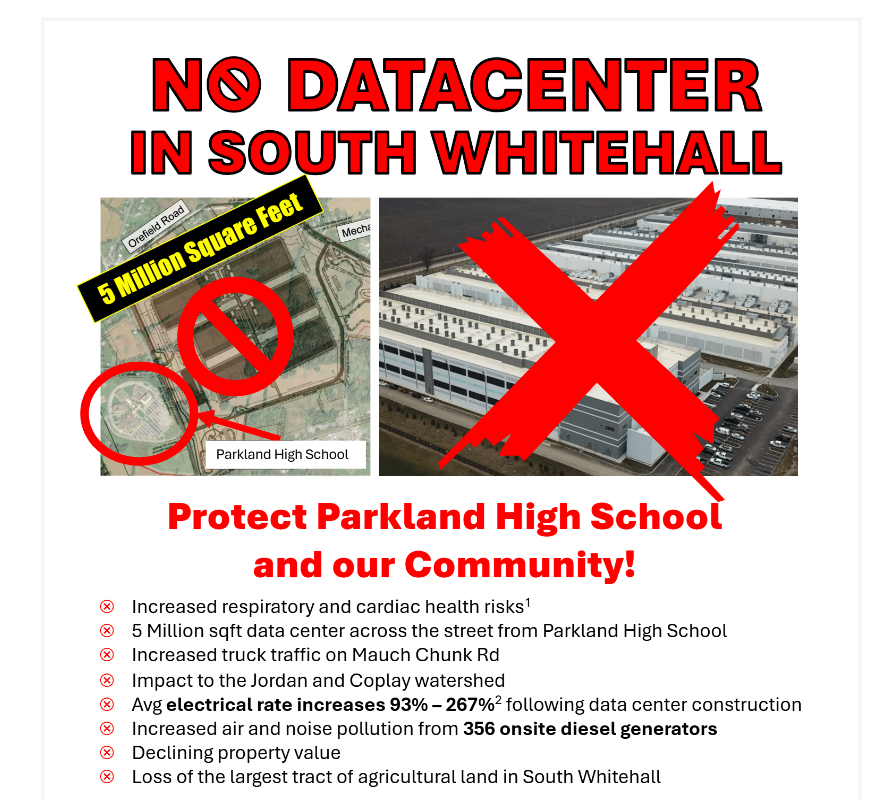
What's the alternative proposal to a hyper datacenter if we want to stay competitive? Opponents to huge data centers advocate for smaller, distributed data hubs, stricter energy and water efficiency standards, scaling back on tax breaks and incentives for people building the data center. They also favor restricting where a data center can be built (staying away from residential or rural areas in favor to placing them in already established industrial centers).
At the core, a lot of the opposition to AI is that it's coming too fast. People fear a loss of control, losing their jobs to AI, ethic risks, unreliable or unsafe outputs and a basic misunderstanding or misinformation about what artificial intelligence is all about.
Right or wrong, artificial intelligence isn't going away. We can either get on board and embrace and utilize the technology to better our lives or wring our hands and hope that our worst fears aren't realized. In my humble opinion, there's a middle ground where we approach what could be the greatest technological advancement of our generation with intelligence and an open mind. There are certainly ethical and regulatory methods of keeping our nation on the forefront working in conjunction with the rest of the world. It doesn't have to be the wild, wild west where anything goes or sending us back to the time of the Puritans.


WOW!! There's a lot of information here to think about. Maybe we could build a data center and analyze all this info. That being said, time will tell how far AI will carry into our lives and lively hood. We can evolve and embrace, we can protest and hate, in the end, we will still go forward, not back in technology and knowledge. On another tangent, why does every Democratic ad describe that we must fight and end all of the Republicans actions? Just my 2 pennies.